1. Integers on a number line
Integers are whole numbers and their opposites: …, −3, −2, −1, 0, 1, 2, 3, … We use them for temperatures, floors below ground, and money owed. The further left on the number line, the smaller the value — so −8 is less than −5.
!A number line from −10 to 10 with negatives in red and positives in green

Worked example. Order −5, 2, −1, 4, 0. Reading left to right on the line: −5, −1, 0, 2, 4.
2. Multiplicative place value
Each place is 10× the place to its right and 1/10 of the place to its left. This keeps working past the decimal point into tenths and hundredths. In 4.56, the 5 means 5 tenths (= 50 hundredths). Multiplying by 10 shifts every digit one place to the left; dividing by 10 shifts one place right.
3. Square, prime and composite numbers
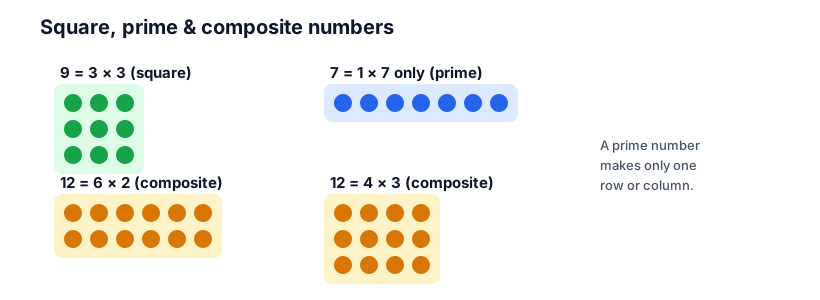
Build the number as a rectangle (array):
- a square number makes a square array (9 = 3×3);
- a prime number makes only a single row or column (7 = 1×7) — exactly two factors;
- a composite number makes more than one rectangle (12 = 6×2 = 4×3 = 12×1).
!Counter arrays showing 9 as a square, 7 as a prime row, and 12 as composite rectangles
Note: 1 is neither prime nor composite — it has only one factor.
4. Fractions and common percentages
On a 0–1 line, 1/4 = 0.25 = 25%, 1/2 = 0.5 = 50%, 3/4 = 0.75 = 75%, and 1/10 = 0.1 = 10%. To order fractions with related denominators, rename them with a common denominator (e.g. 1/2 = 2/4) and compare.
Curriculum: WA6MNAUN1–UN5.